


When and how to charge? Charging options for electric straddle carriers
Key takeaways
- Kalmar's Gen 2 battery offers 533 kWh nominal capacity and five to ten hours of operating time, with MCS and FastCharge enabling a full recharge in 45–50 minutes — making around-the-clock electric operation achievable.
- Terminals can choose between depot charging, opportunity charging, or a combination of both, depending on their shift patterns, break schedules, and infrastructure constraints.
- Electric straddle carriers require approximately 30% higher upfront investment, but deliver around 20% lower annual operating costs — with opportunity charging further reducing any performance impact of the transition.
- Kalmar can support terminals in planning for fleet electrification, starting with partial fleets and progressing towards full electrification.
Today's terminal operators face a common list of questions and concerns when planning their electrification journey. Will there be enough grid capacity and green energy available to charge a fleet of electric machines? Will a shift to a new electric infrastructure require prohibitively large investments? How will the charging of battery-powered equipment affect everyday operations? And, finally, will more straddle carriers be required to reach the same terminal throughput? In this article, Kalmar's experts break down some of the key considerations, available options and possible charging strategies for electrifying straddle carrier terminals.
In an electric straddle carrier fleet, the chosen technical equipment and charging strategy is directly linked to operational considerations. For example, the availability and capacity of grid power will affect the charge scheduling and optimisation for larger equipment fleets. Thus, any decision to electrify a straddle carrier fleet involves both operational and technical factors.
"On the operational side, there are few items that you should be thinking of, starting with the operating hours per day," says Mikko Nurmela, Senior Development Manager, Kalmar. "What kind of work time and break pattern you have in your operation will affect your charging needs, as will the type of duty cycle you are running, whether it is light, medium or heavy-duty operation."
What kind of work time and break pattern you have in your operation will affect your charging needs, as will the type of duty cycle you are running, whether it is light, medium or heavy-duty operation.
The Kalmar electric straddle carrier offers a net operating time of approximately 300–600 minutes, depending on how the machine is operated and operational conditions. The new Gen 2 battery offers a nominal capacity of 533 kWh and a usable capacity of 453 kWh.
The Kalmar Charge Family is a comprehensive offering of charging solutions and supportive products designed to help operators of both manual and automated terminals with their transition towards decarbonised operations. The offering includes three different charging technologies that can be deployed based on the individual operational needs of the terminal. Using the Kalmar Megawatt Charging System (MCS) or the handsfree Kalmar FastCharge™ technology, the battery can be recharged in 45–50 minutes. With standard CCS charging, it typically takes 65–70 minutes. "By utilizing operational waiting times for charging, we can again reach continuous around-the-clock operation without any impact on terminal performance," notes Nurmela.
By utilizing operational waiting times for charging, we can again reach continuous around-the-clock operation without any impact on terminal performance
Managing peak loads
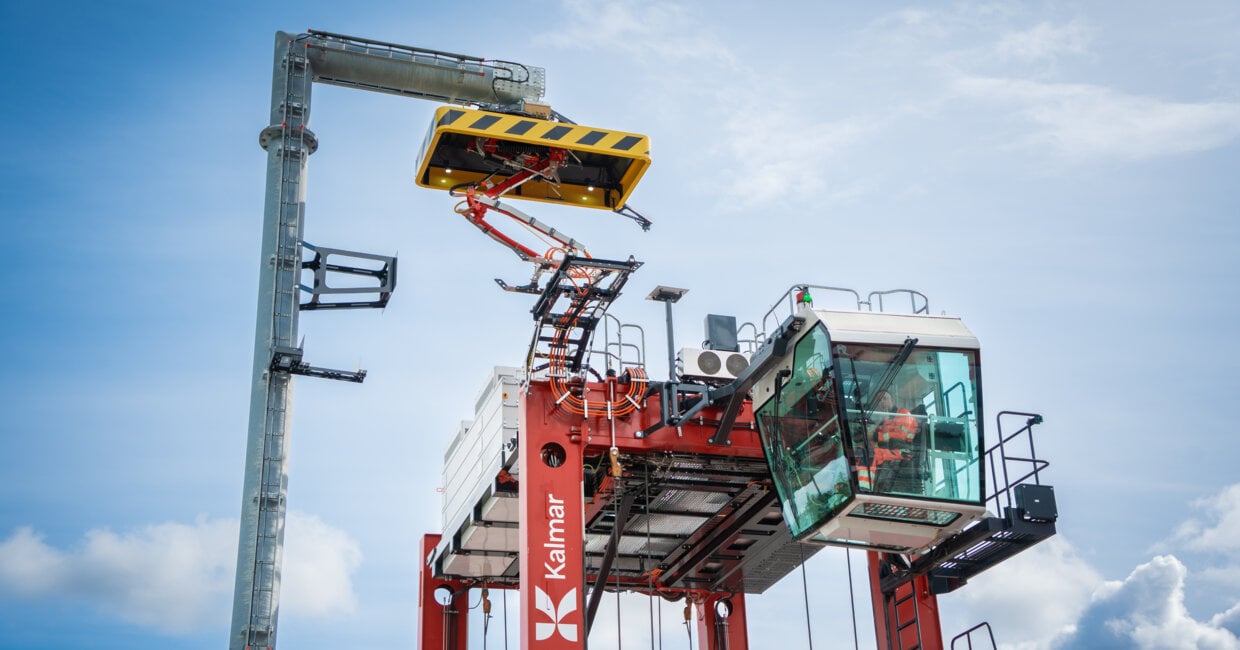
Kalmar electric straddle carriers are available with industry standard CCS1/CCS2 charging interfaces as well as with Kalmar's inverted pantograph charging system (FastCharge) and Kalmar Megawatt Charging System (MCS). The Kalmar Megawatt Charging system currently supports charging of Kalmar electric straddle carriers at up to 500kW, with full megawatt-level charging expected to be available for the next generation of batteries. The handsfree FastCharge pantograph system is developing rapidly and can currently handle charging at currents of up to 1,000 A. Up to two machines can be charged simultaneously at a single FastCharge pole.
"In operations where rapid charging is required and the batteries are charged during lunch breaks, the overall terminal infrastructure and electrical supply needs to support the simultaneous charging of the whole fleet," says Aki Heikkinen, Sales Development Lead, AMEA, Kalmar. The benefit of this so-called Depot charging strategy is that it only requires few operational changes and only a single point of electricity.
In operations where rapid charging is required and the batteries are charged during lunch breaks, the overall terminal infrastructure and electrical supply needs to support the simultaneous charging of the whole fleet
An alternative approach is opportunity charging, which makes use of operational waiting times to enable fast and frequent charging throughout the working day. "With faster opportunity charging, terminals can achieve lower peak power consumption, but the charging infrastructure needs to be distributed in operational hotspots around the site." says Aki Heikkinen. Terminals may also choose to combine both strategies, enabling so-called hot-seat operations, particularly beneficial for terminals with limited or no scheduled breaks.
The differences between required peak power can have a significant impact on the choice of charging solution. An electric straddle carrier uses an average power of around 50 kW, so a typical fleet of 50 machines would consume 2.5 MW of power during normal operation. When charged simultaneously with a 350 kW CCS2 charging interface, the same fleet would require a peak power of 17.5 MW during lunch breaks. With 10 FastCharge stations charging the fleet of 50 machines during operations, the system would require only approximately 6 MW of peak power distributed evenly for the whole operational time.
Faster charging available
The new Kalmar Megawatt Charging System (MCS) enables significantly faster charging of straddle carriers compared to traditional CCS systems, allowing terminals to charge more vehicles during breaks and maximize uptime. Faster charging directly improves machine availability and lowers the total cost of ownership of the fleet. The Automated Megawatt Charging System is currently under development and is bringing rapid charging also to the automated straddle carrier once available.
The hands-free Kalmar FastCharge™ System includes the delivery of the container-based charging stations, as well as the pantograph equipment and their poles. The Kalmar FastCharge™ is available for both manual and automated operations. The FastCharge station is powered by a medium-voltage power supply and is delivered with the necessary transformer and switchgear included. The terminal infrastructure is generally handled by the customer, so the terminal would need to consider factors such as the location of the charging interface in the yard, the foundation works for the station and pole, as well as the electrical, cabling and connectivity work needed at the site.
Charging at the right time
Kalmar One Scheduler for automated straddle carriers is a KalmarOne automation system solution for job scheduling, dispatching and optimisation. The scheduler also assigns optimised charging tasks, minimising the need for more equipment.
"Scheduler basically schedules and dispatches the charging events in exactly the same way as the container moves," says Aki Heikkinen. "The solution also monitors battery levels and energy consumption across the entire fleet, ensuring that all machines are charged when needed. In addition to maintaining appropriate charge levels for all machines, Kalmar’s Scheduler also optimises the usage of charging stations in order to avoid congestion."
The solution also monitors battery levels and energy consumption across the entire fleet, ensuring that all machines are charged when needed.
For manually operated straddle carriers, the Kalmar SmartCharge solution offers similar functionality. Also intelligent charge management is available depending on the grip capacity, operational demand and number of machines per charging station. This supports maximising the battery lifetime.
Evaluating the overall impact
The main difference in total cost of ownership between hybrid and electric straddle carriers is the significantly different balance between capital and operating expenses. Electric straddle carriers require an approximately 30% higher initial investment due to the cost of the batteries and chargers for the equipment. However, they also offer an approximately 20% lower annual operating cost thanks to savings in energy and maintenance expenses.
"Over the long term, electric straddle carriers offer a very competitive total cost of ownership," notes Mikko Nurmela. "Once opportunity charging is built into the natural flow of operations, it will mitigate any performance impact of electrification. So, it is quite realistic to expect that a terminal wouldn't necessarily need any additional machines when transitioning to electrified operation."
Over the long term, electric straddle carriers offer a very competitive total cost of ownership.
Total Cost of Ownership (TCO) Calculator
How would it impact your total cost of ownership (TCO) if you switched to hybrid or fully electric straddle carrier.
Simply enter your current energy and diesel cost to find out.
Results
Hybrid: -%
Battery Electric: -%
Proven in action
Kalmar electric straddle carriers are already in service at multiple terminals around the world. At DP World London Gateway, Kalmar delivered twelve new fully electric straddle carriers in December 2025, expanding the terminal’s electric straddle carrier fleet to a total of 21 units. The twelve new Kalmar electric straddle carriers are equipped with the MCS interface and are now fully operational.
At ECT Rotterdam, two new Kalmar electric straddle carriers will support the terminal's goal of achieving emission-free operations at its key terminals by 2035. The terminal is piloting two Kalmar electric straddle carriers with different battery capacities.
At Finnsteve’s Vuosaari Harbour in Helsinki, three electric straddle carriers will supplement the existing fleet of 13 diesel units, reinforcing the port’s commitment to sustainability and helping to reduce port operations’ CO₂ emissions by up to 13 per cent. The delivery is scheduled for Q2 2026, including two hands-free charging interfaces.
At APM Terminals Pier 400 in Los Angeles, two electric Kalmar AutoStrad™ are supplementing an existing fleet of 132 AutoStrad™. Additionally one Hybrid AutoStrad™ has been modernised with a battery, and another Hybrid AutoStrad™ modernisation is scheduled for the second half of 2026. These machines are charged with two hands-free FastCharge stations.
"One of the benefits of the Kalmar straddle carrier is that it's designed as a modular machine," notes Aki Heikkinen. "So basically, we are just exchanging the hybrid power unit with a fully electric high power battery pack and its associated systems. The initiative at Pier 400 has been a particularly interesting pilot project, and we are really excited to see the long-term results from our customer on this one."
The initiative at Pier 400 has been a particularly interesting pilot project, and we are really excited to see the long-term results from our customer on this one.
A change in mindset
Electrifying a straddle carrier operation is a wide-ranging task that calls for a shift in perspective for terminal operators.
"It's not only about the equipment itself, but also related to the way you are operating today, as well as how you can utilize your operation in the best possible way in the future with electric equipment," says Sami Yli-Ayho, Senior Manager, Product Management, Horizontal Transportation, Kalmar. "At the moment, Kalmar can offer two alternatives for battery technology, based on either opportunity charging for hot seat operation or shift change type scheduling. The best choice will depend on the individual operation of the terminal or can be a combination of the two.”
"Electrification is no longer just about the machines," adds Mikko Nurmela. "It's about the wider ecosystem within which we need to consider all the options and opportunities, whether these relate to new technologies or energy sources. The market is developing very fast, so we'll certainly see more innovations in the field within the next two to three years."
Read also our Myth busting series on electric straddle carriers, starting with: Myth #1: Electric straddle carriers reduce operational efficiency and reliability
Related articles
Further reading
Subscribe and receive updates in your email
Meld je aan voor onze publicaties